
Interlock and pavers
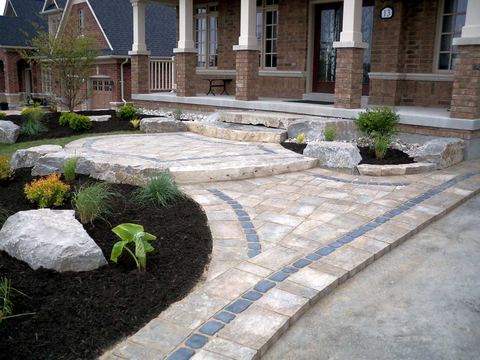
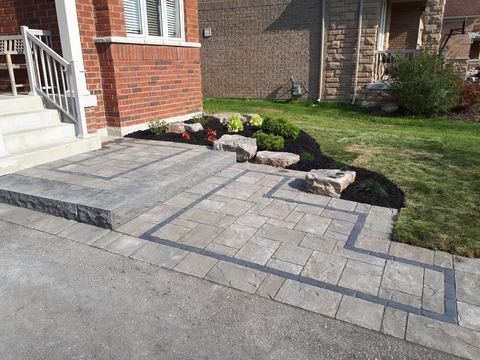
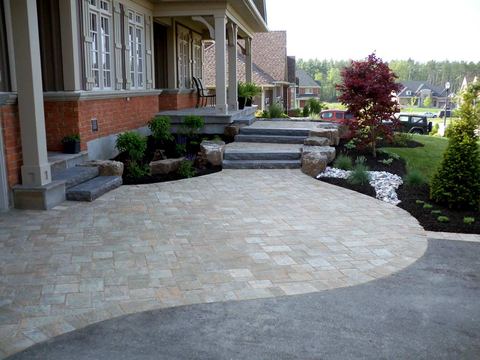
Interlock installation for landings, walkways and patios, with a darker border band if you want one, and pavers along the driveway. Laid flat, cut straight.
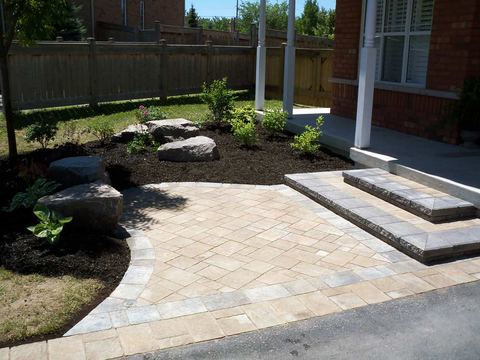
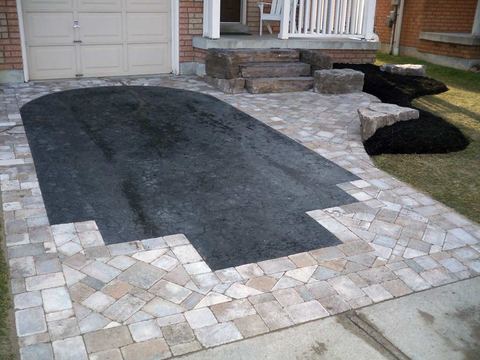
What we build in interlock
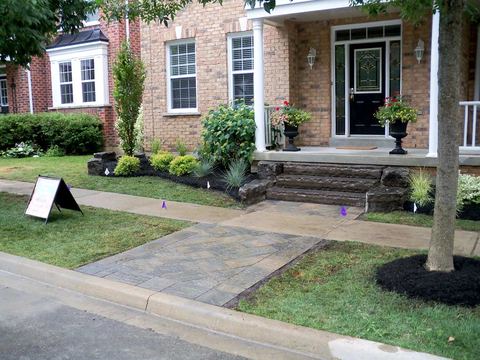
- Landings at the front door, square or round, sized to your door.
- Walkways from the drive to the door, and along the side of the house.
- Border bands: a row of darker pavers around the edge to frame the walk.
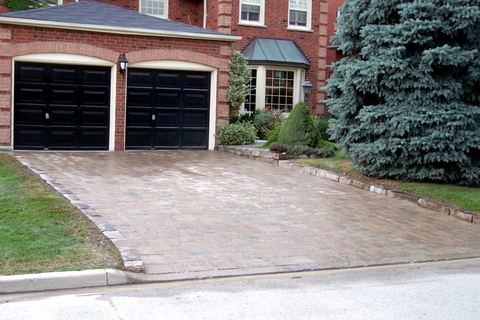
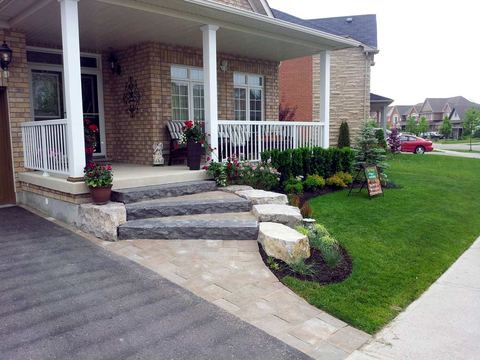
- Driveway accents: an interlock border along the asphalt, or a band where the drive meets the walk.
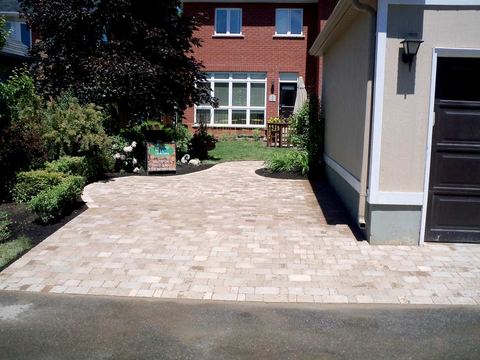
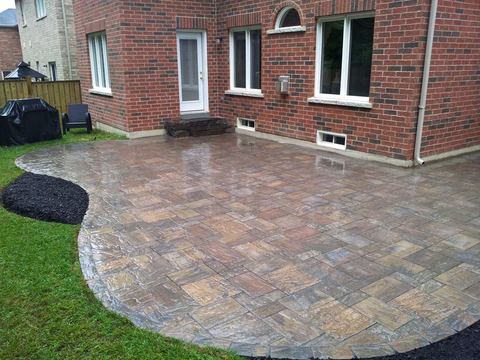
- Patios off the back or side of the house.
What interlock is
Interlock is a surface of concrete pavers laid tight together on a bed of sand over a packed stone base. Sand swept into the joints and a firm edge along the sides lock the pavers to each other, so the surface moves as one piece instead of each paver rocking on its own. Pavers for walks, patios and driveways are commonly 60 mm thick.
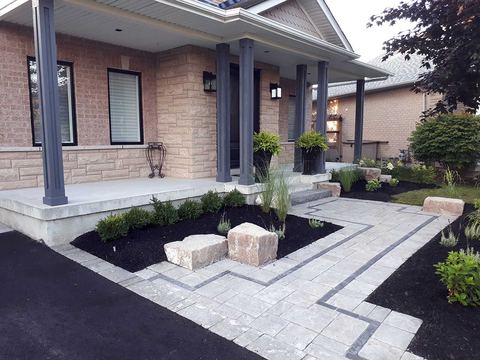
Pavers come in many shapes and colours. A border band in a darker colour, like the charcoal edges in our photos, frames a walk or a landing and gives the eye a clean line to follow.
The pattern matters too. For streets, the paver industry recommends a herringbone pattern, so it is worth asking about where cars turn on a driveway accent. On a walk or a landing the pattern is more about the look. We’ll help you pick when we come out.
Where the work shows: the cuts
Good interlock shows in the cuts: where the walk meets the driveway, the steps, a curve or a border band. A crooked cut is easy to spot. On ours, every cut line is straight.
We use string lines to cut interlock and asphalt banding straight. On a straight edge, every cut sits on one line from end to end. On a curve, every paver along the edge is cut to one smooth line.
How we build it
- The old surface or sod comes out, along with the topsoil, the triple mix and every root. Roots rot, leave a hollow, and the pavers above sink. Clay can be hard enough to build on; if it isn’t, it gets dug out. Every site is different.
- A drainage base goes in. Every walkway and patio we build gets one.
- The pavers go down to the shape you agreed, and the edges are cut straight.
- The lawn and beds are finished back to the new edge.
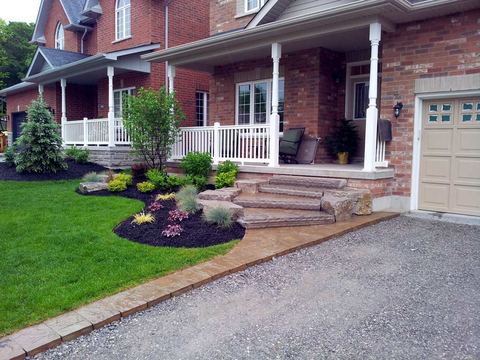
An interlock walk or landing can be one part of a front entrance, like the walk in our bungalow front yard. We lay it in Uxbridge, Port Perry, Stouffville and the surrounding areas.
If you’re deciding between interlock and natural stone, our guide lays out the differences.
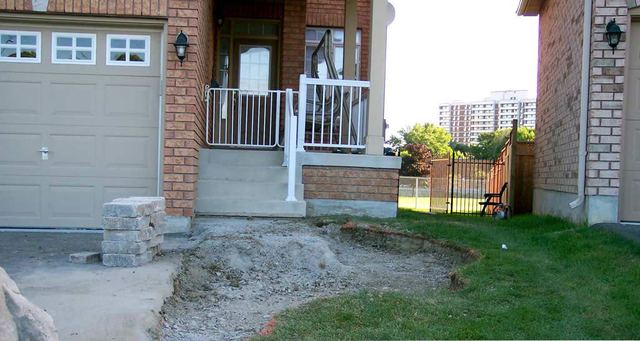
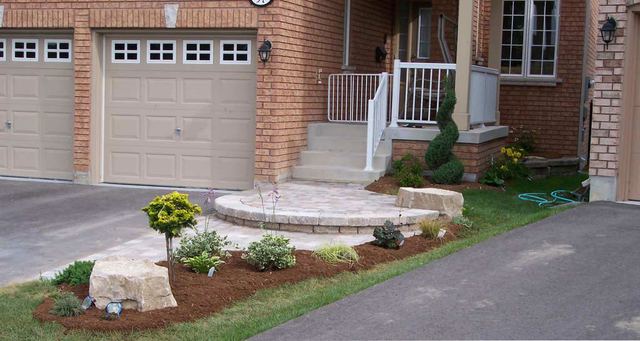
Before and after: a round landing by the garage
A dug-out walk and bare gravel between the garage and the porch, rebuilt with a round interlock landing, a planted bed and armour stone. Drag the line to compare.
Driveway accents
Interlock where the driveway meets the house: an apron, a parking pad, a border along gravel. Tell us what you have in mind.
What industry guidance says goes under interlock
What you walk on is the top 60 mm. What keeps it flat is everything under it. Below is general industry guidance from the Concrete Masonry and Hardscapes Association (CMHA, formerly ICPI), in short form. It is the industry’s general picture, not a spec for your yard. What your yard needs gets worked out on site.
A packed base
CMHA’s general guidance for the base is at least 100 mm (4 in.) after packing for walks and patios on well-drained soil, and at least 150 mm (6 in.) for a residential driveway, thicker in cold climates and on wet or weak soil.
CMHA says to spread it in layers, pack each one with a plate compactor, and never place it on frozen ground.
Slope for the water
The guidance is that the surface slopes so water runs off, away from the house. CMHA’s minimum is 1.5%, about 1.5 cm of drop for every metre.
A thin bed of sand
In CMHA’s guidance, bedding sand is screeded flat to about 25 mm (1 in.). CMHA says not to use stone dust, screenings or masonry sand for it, and not to use extra sand to hide a lumpy base.
Edges that hold
CMHA calls edge restraints “a key part” of interlock: they keep the pavers locked to each other.
Full joints
In CMHA’s method, dry joint sand is swept in and the pavers are packed again until the joints are full. That sand is what makes interlock lock.
Polymeric sand, a joint sand that firms up when wet, is optional on most jobs. CMHA recommends a stabilized joint on slopes over 7%.
Caring for interlock: salt, joints and weeds
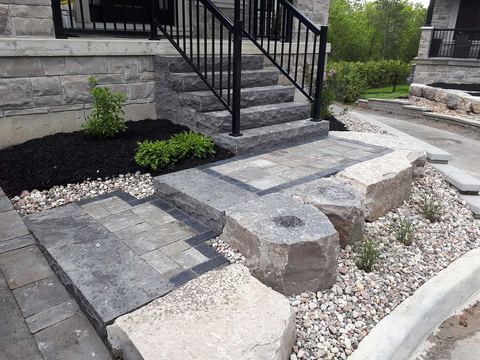
Interlock needs little care, but winter is where it gets tested.
CMHA says plain rock salt is the least damaging de-icer for concrete and should be used whenever you can, with calcium chloride used carefully when you need something stronger. It does not recommend magnesium chloride or CMA.
Use as little as works, shovel first, and keep salt off the beds. Unilock, one paver maker, also suggests a plastic shovel instead of a metal blade, and its residential guarantee covers reasonable use of rock salt. Check the guarantee for the pavers you choose.
Watch the joints. If the sand has dropped more than about 12 mm (half an inch) below the top of the pavers, CMHA says to top it up right away, and not with polymeric sand: it works when a joint is filled fresh, not as a top-up. Full joints keep the pavers locked and leave less room for weeds.
Weeds in interlock don’t come up through the base. CMHA notes they grow from seeds that blow into the joints, so a sweep and a pull now and then, and full joints, keep them down.
A white, powdery haze in the first months is usually efflorescence. It is common on new concrete, it doesn’t hurt the pavers, and some of it wears away on its own.
Sealer is optional. It can help pavers stand up to salt, and it needs redoing after wear and weather.
Interlock or natural stone?
It depends on the budget. Interlock gives you clean lines, lots of colours and patterns, and a surface that can be lifted and relaid if it ever settles.
For steps, if the budget allows, we suggest natural stone slabs. Our steps page explains why.
Many of our front entrances use both: natural stone steps at the door and an interlock walk or landing below them. Our interlock or natural stone guide lays out the differences.
Questions about interlock
Is my interlock job too small for you?
No. No job is too small, and we do repairs too.
Do you do full interlock driveways?
Tell us what you have in mind when you call, and we’ll talk it through on site.
What goes under interlock?
A packed stone base under a thin bed of sand. The paver industry’s general guidance (CMHA) is at least 100 mm of packed base for walks and patios on well-drained soil, and at least 150 mm for a driveway, more on wet or weak soil.
Why are my interlock pavers sinking?
Usually the base: too thin for the soil, not packed in layers, or put down on frozen ground. Extra bedding sand used to level a lumpy base settles too. Interlock can be lifted, the base fixed and the pavers relaid.
Can you fix or relevel an old interlock walk?
Yes, we do repairs. We’ll tell you on site whether it is a repair or a rebuild.
When is the best time to book interlock?
Late fall, for the next spring, because spring books up the fall before. We don’t do winter work.
Planning an interlock job?
Call, text or email. Someone from our crew will come out, talk it through and send you a quote.