
Interlock or natural stone for steps and walkways?
The short answer
It depends on the budget. If the budget allows, we use natural stone slabs for steps, because precast and other man-made blocks shift with frost over the years. Precast is fine when the budget calls for it, and done well it shouldn’t move for a long time. Interlock is uniform, comes in many colours and patterns, and is easy to repair because single pavers lift out. Many good front entrances use both: natural stone steps with an interlock walk.
This guide is general information, checked against its sources November 26, 2026.
What we mean by interlock and natural stone
Interlock is made of concrete pavers. They come out of a mould, so every one in a batch has the same size, thickness and colour. For walks, patios and driveways, the industry standard paver is 60 mm (2 3/8 in.) thick.2
The pavers sit tight together on a bed of sand over a packed gravel base. Sand in the joints and a firm edge along the sides lock them to each other. That is where the name comes from.
Natural stone is cut or split from a quarry. On a front entrance it usually shows up three ways:
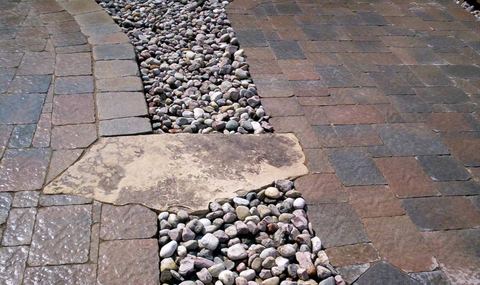
- Flagstone: thin, flat pieces, often irregular in shape.
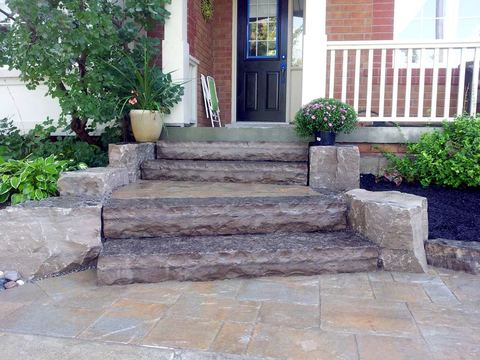
- Slab steps: one long, solid piece of stone per step.
- Armour stone: big, squared blocks used for steps, walls and edges.
No two pieces of rock are the same, so each piece is a little different in colour, texture and thickness.
Side by side
| Interlock pavers | Natural stone | |
|---|---|---|
| Look | Even, regular, crisp. Many colours, borders and patterns. | Heavier, rougher, every piece different. Reads as permanent. |
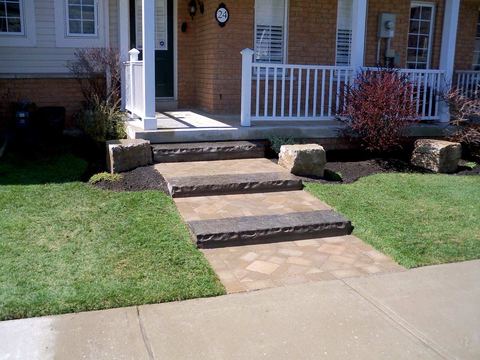
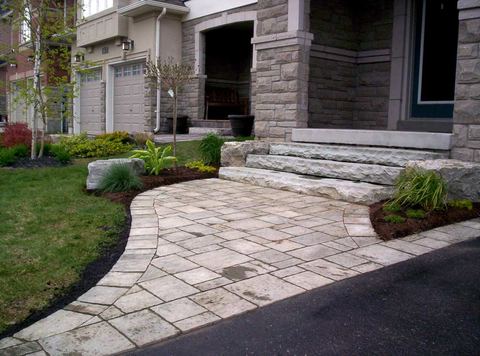
| Steps | Built up in units, matched to an interlock walk. | Long single slabs or armour stone blocks per tread. |
| Frost over the years | Man-made steps shift with frost over time. Done well, they shouldn’t move for a long time. | Our choice for steps when the budget allows. Heavy single slabs, set on a concrete slab. |
| Repair | Single pavers lift out, the base is fixed, the same pavers go back. | Slabs are big and heavy; resetting one is a bigger job. |
| Stains | Dense, so it resists stains better.1 | Flagstone is porous and can stain; a paver maker suggests resealing every few years.1 |
| Freeze-thaw | Holds up when the base drains. | Flagstone can flake or crack over freeze-thaw.1 Any stone holds up best on a solid, well-drained base. |
Our view: natural stone for steps, if the budget allows
We build both, and we don’t push one. It comes down to the budget and the house. But when we’re asked which we’d choose for front steps, and the budget is there, the answer is natural stone slabs.
The reason is frost. Over the years, frost works on precast steps and other man-made blocks, and they shift. Natural stone slabs are single, heavy pieces, and natural stone steps sit on a concrete slab.
That doesn’t make precast wrong. When the budget calls for it, precast is fine, and precast done well shouldn’t move for a long time. The base under it is what makes the difference. Interlock is still a great choice for the walk and the landing, where its clean lines and easy repairs count.
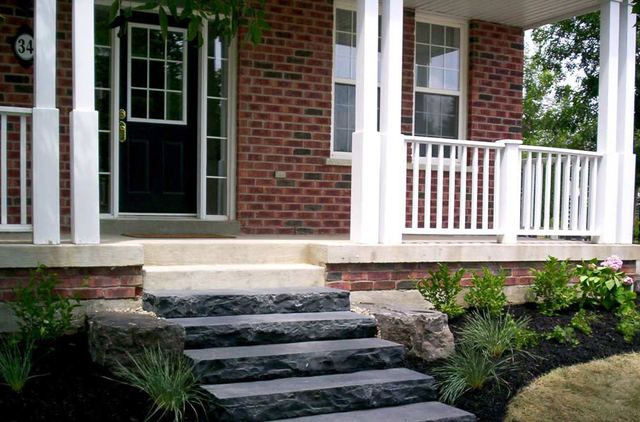
That job is written up in full in precast steps to natural stone.
The base matters more than the stone
Whichever you choose, what’s under it decides how long it stays flat. A walk or a step that sinks or heaves almost always has a base problem: not dug deep enough, not packed, or holding water that freezes.
Every site is different, so the base starts with what we find when we dig. How we prepare the ground is on our walkways, patios and armour stone pages, and the general industry guidance on base depth for pavers is on our interlock page.
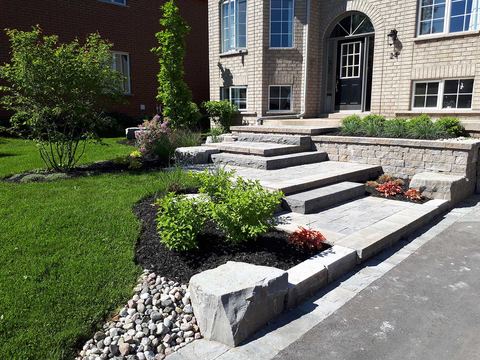
How natural stone is set
Natural stone has more than one way in. A trade article on stone paving describes the main methods.6
- Sand set: the stone sits on a sand or fine gravel bed over a packed base, much like interlock. The article says it “offers both permeability and some flexibility”.
- Mortar set: the stone is bedded in mortar on a concrete slab, which makes a rigid surface. The article says getting water off the surface is key with this method.
Both need even support under every piece. As the article puts it, “uniform support of the paver is critical”.
Big pieces are their own job. A one-piece slab step or a block of armour stone is far too heavy to set by hand. It goes in with a machine and gets levelled on its base, one piece at a time.
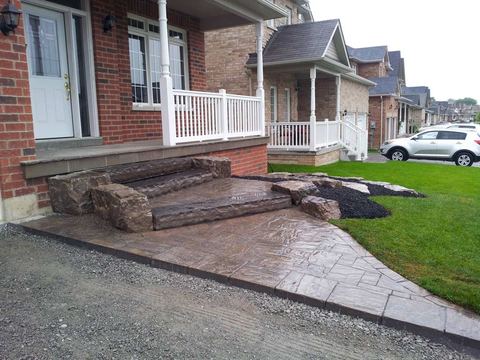
Frost and heave
Frost is why a walk that looked perfect in September can have a lip in March. It isn’t just water swelling as it freezes. Canada’s National Research Council explains that in fine soils, growing ice pulls more water up from the ground around it and builds layers of ice that push the ground up.7
It lists three things frost heave needs:
- Freezing in the soil.
- A fine soil that water can move through.
- A supply of water.
Take one away and the heave stops. The usual cure, the same paper says, is to replace the fine soil with coarse granular material and to pay careful attention to drainage.7 That is what a packed gravel base and a proper slope are doing under a walk.
Neither material can stop frost on its own. What changes is how each one shows the movement:
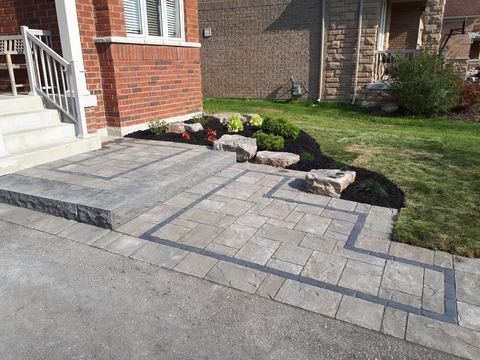
- Interlock is many small pieces, so a small heave shows as a few pavers out of line. They can be lifted, the base fixed, and the same pavers put back.
- Flagstone in sand behaves much the same way, though the uneven shapes make a lifted edge harder to spot and to fix.
- Stone set in mortar moves as one piece. If the slab under it shifts or cracks, the joints and the stone can crack with it.
- Precast steps and other man-made blocks shift with frost over the years. That is the main reason we choose natural stone for steps when the budget allows.
- Heavy slab steps and armour stone are single big pieces, so they take a lot to move.
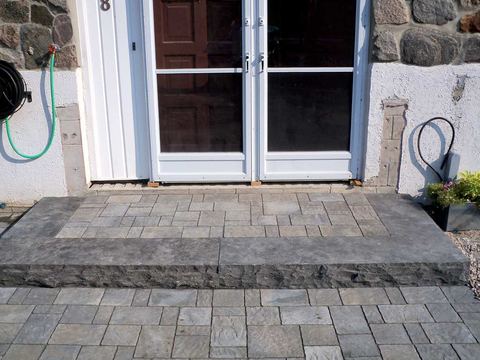
Repairs: when something moves
Every hard surface outside settles, gets dug up or gets damaged at some point. A tree root lifts an edge. A corner sinks where a downspout empties. How easy the fix is depends a lot on the material.
Interlock is built to be opened and closed. The industry’s maintenance guide says pavers “act as a zipper in the pavement”. Pavers in a low spot “can be removed, the settlement adjusted” and put back, and it advises keeping every undamaged paver for reuse.3 Ask for a few spare pavers from the job and keep them in the garage. A matching spare makes a cracked one easy to swap.
Natural stone repairs are bigger. A sand-set flagstone can be lifted and reset, but a broken piece is hard to match, because no two pieces are the same. A mortar-set stone has to be broken out. A heavy step that has tilted comes out with a machine, gets a new base, and goes back in.
None of that is a reason to avoid natural stone. It is a reason to get the base right. And if you already have steps or a walk that have moved, we do repairs. No job is too small.
Care through the year
Neither one needs much, but a few habits help both last.
For interlock, the care is mostly joints, weeds and winter salt, and our interlock page covers it.
Natural stone
- Keep water moving off it. Point downspouts away, and watch for puddles that stay after rain.
- If you choose to seal flagstone, a paver maker says to reapply every 3 to 5 years.1 Stones differ, so ask about the right sealer for yours.
- Wipe up oil and other spills quickly on porous stone.
- Go easy with de-icer on stone. The paver industry’s de-icer advice is written for concrete, not natural stone.
- Each spring, look for any piece that has rocked or lifted, and have it reset before it becomes a trip edge.
What makes either one last
You will see claims online about how many years each material lasts. We don’t give a number, because it depends on the job more than the stone. What decides it:
- The base: firm ground, built for the soil on the site.
- Drainage: a slope that sends water off the surface and away from the house.
- Edges: pavers held in by a firm edge, and stone held by something solid at the sides.
- The material: a dense stone that handles freeze-thaw, or pavers made for a northern climate.4,5
- Winter habits: how much salt, which kind, and whether the snow is shovelled first.
- Small repairs done early: a topped-up joint or a reset paver in spring stops a small problem growing.
Steps, walkways and landings: which suits where
Most front entrances have three parts: the walk, the steps and the landing at the door. Each one asks something different of the material.
Steps
Steps take the most wear and the most salt, and they are where a small error shows most. Comfortable steps are even from top to bottom and not too steep. A step that is a little taller than the rest is where people trip.
This is where we lean toward natural stone when the budget allows. A one-piece slab has no joints across the step and a lot of weight behind it. Interlock and precast steps match an interlock walk well, and they are the right call when the budget asks for it.
Walkways
A walk is a long, flat run, so it is about drainage, edges and straight lines. Interlock does this very well: a border band makes a clean edge, and a curve is easy to lay. Flagstone gives a softer look that suits a garden path. Irregular flagstone with uneven tops can catch a toe, which a paver maker also points out.1
Landings
A landing is where people stand, open the door, put down groceries and stamp off snow. It needs to be big enough to open the door without stepping back down. Interlock makes a large, even surface, and a border band frames it neatly. A big stone landing looks grand, but large flat slabs are heavy, and a landing of small flagstone has more joints to care for.
Mixing the two
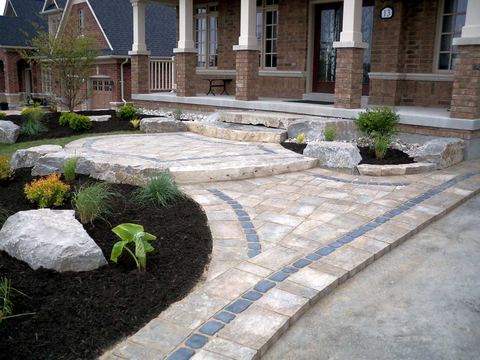
You can mix them on purpose: natural stone or armour stone for the steps, where the weight and the look count most, and interlock for the walk and the landing, where a border band frames it and repairs are easy. Our front entrances page shows the options.
Questions worth asking about any job
These get you a clearer answer than “which is better?”
- What comes out before the base goes in?
- What will go under it, and how will it be packed?
- Where will the water go when it rains, and when the snow melts?
- What holds the edges?
- How will the step heights be kept even from top to bottom?
- What should I use on it in winter, and what should I avoid?
- If a piece moves or cracks later, how is it fixed?
Which would we use at your house?
It depends on the house, the slope, what you like and the budget. When someone from our crew comes out, we’ll tell you on site which suits your steps and which suits your walk, with the reasons for your yard.
See interlock and pavers, steps and landings and patios for more of each.
Common questions
Will precast steps move?
Over the years, frost works on precast and other man-made blocks, and they shift. Precast done well, on a good base, shouldn’t move for a long time. That is why we choose natural stone slabs for steps when the budget allows.
What do you put under natural stone steps?
Our natural stone steps sit on a concrete slab.
Which one lasts longer?
The base, the drainage and the edges decide that more than the material. A well-built paver walk and a well-built stone walk can both last a very long time. A poor base fails under either one. Winter habits and small repairs in spring matter too.
Why are my pavers heaving or sinking?
Usually the base: soft soil left under it, a base that wasn’t packed, or water that sits and freezes. Pavers at an edge can also creep and sink if the edge gives way, and a corner can wash out where a downspout empties. Pavers can be lifted, the base fixed and the same pavers put back. We do repairs.
Do I need to seal flagstone or pavers?
Sealing is optional for both. A sealer cuts down on stains and water getting in, and it has to be reapplied over time. One paver maker, Unilock, suggests every 3 to 5 years for flagstone if you choose to seal. Pick a sealer made for your material.
Can I mix interlock and natural stone?
Yes, and many front entrances do. A common mix is natural stone or armour stone steps with an interlock walk and landing. The steps get the weight and the look, and the walk gets clean lines and easy repairs.
Sources
- Unilock (a paver maker, so read it as their view), “Flagstone challenges”: unilock.com.
- Concrete Masonry and Hardscapes Association (formerly ICPI), Tech Note PAV-TEC-002-22, “Construction of Interlocking Concrete Pavements” (revised 2022): cmha.org.
- Concrete Masonry and Hardscapes Association, Tech Note PAV-TEC-006-22, “Operation and Maintenance Guide for Interlocking Concrete Pavement”: cmha.org.
- Concrete Masonry and Hardscapes Association, PAV-FAQ-001-18, “The Effects of Deicing Chemicals on Interlocking Concrete Pavers” (revised 2018): cmha.org.
- Natural Stone Institute, “Limestone”: naturalstoneinstitute.org.
- Jason Kron, “Natural stone pavers: installation methods for success”, Stone World (February 1, 2021): stoneworld.com.
- E. Penner, National Research Council Canada, Canadian Building Digest CBD-26, “Ground Freezing and Frost Heaving” (1962), archived copy: web.mit.edu.
Still deciding?
We’ll talk it through on site. Call, text or email.